


Putting humanoids to work on Europe’s factory floors: Why We Invested in Motion1

The interesting question about humanoid robots is no longer whether they work. More than 100 OEMs are shipping or close to shipping production units, unit prices have fallen from above $150k in 2022 to roughly $30k for some models today, and Goldman Sachs now expects 1.4 million units shipped in 2035 into a $38B market, up from 100,000 in 2026.
Hardware has stopped being the binding constraint. The question that matters now is who gets these machines doing useful, reliable, insured work inside a real European factory.
The problem: Buying a robot is only the start
Ask a plant manager in Ghent or Dortmund why there is no humanoid on the line, and the answer is almost never that the robots cost too much. Four things stand in the way of early adopters today:
Choice. Which of several hundred tasks on a site is worth automating, and which of dozens of available models can actually do it? Nobody inside the plant is equipped to answer that.
Training. A humanoid arrives as a general-purpose machine and has to be taught a specific job. Most mid-size companies do not have the in-house robotics talent, and specialist integrators quote 4–8 weeks per task at consultancy rates.
Capital. A deployment is an upfront hardware purchase against an unproven return, landing in a capex budget that was set last year and defended by a CFO who has never seen a humanoid in action and who is operating in economically unstable times.
Trust. A humanoid is a networked, sensor-heavy machine sitting in the middle of a company’s operations. Industrials want to know where the data goes and who is accountable for it, and they want that answer to be European.
Waiting is not a neutral option either. Manufacturers are competing against Chinese plants that already run humanoids at scale, and lose ground every quarter they hold off. Europe is caught between an automation gap it cannot afford and an adoption path it does not trust.
A deployment layer that turns a robot purchase into a monthly service
Motion builds neither robots nor foundation models. It is what the team calls a neo-integrator, sitting between the OEMs and the factory and owning everything that happens after the hardware exists.
Motion’s Field Deployment Engineers take a customer from an idea about a task to a robot doing that task on the line, and stay responsible for it afterwards through fleet management, maintenance and compliance. The platform is deliberately hardware-agnostic and integrates different humanoid models across multiple OEMs, such as Unitree, Agibot, or Germany’s NEURA Robotics in the future. This way, the customer never has to bet on a single vendor, and every deployment feeds experience back across the whole network while each customer’s own data stays its own on a European software layer.
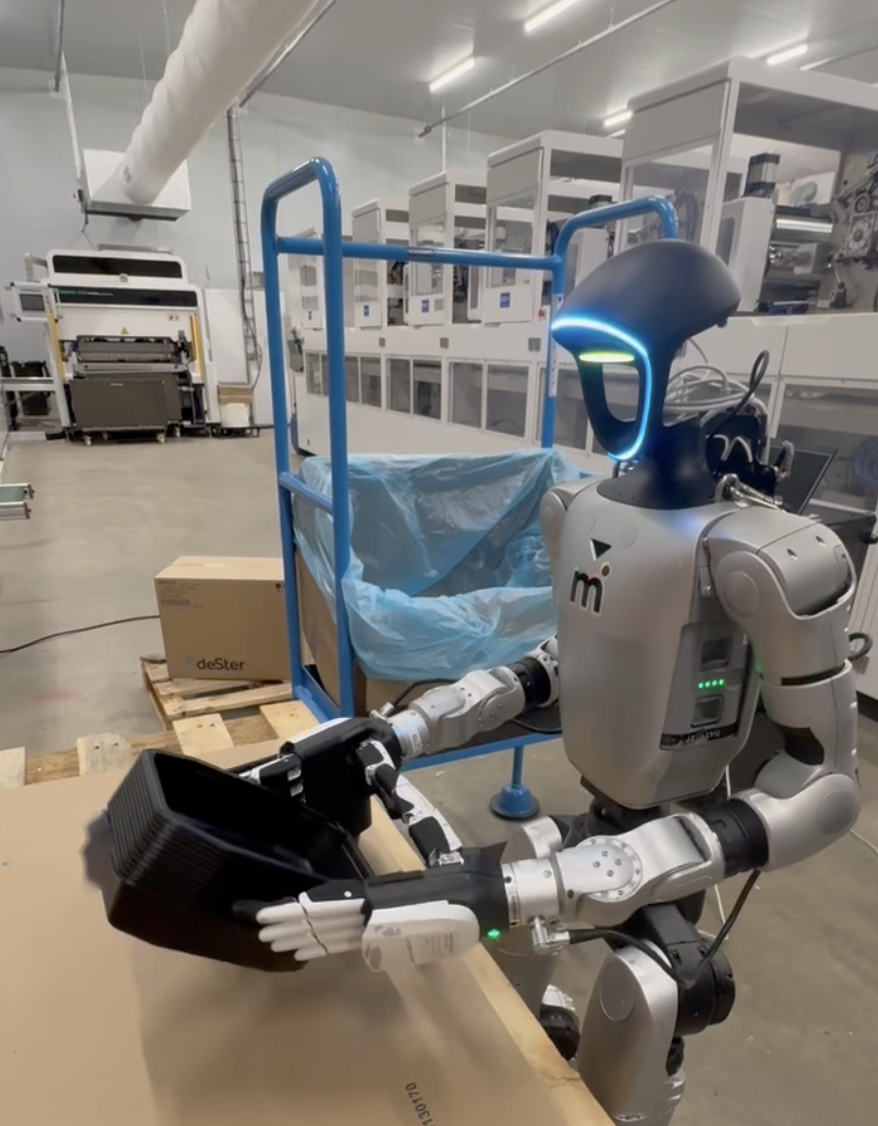
Motion removes the friction for customer adoption by taking the robot off the customer’s balance sheet and bundling everything into one monthly payment: the machine, the software, the insurance and the people who keep it running. Nothing to buy, nobody to hire, no liability to carry.
Six months after founding, this is already running in the field, with five active pilots on European factory floors covering crate handling, packing and line feeding. These are unglamorous, repetitive jobs, which is exactly right. What humanoids do reliably today is narrow, and a deployment company that pretends otherwise burns its first customers.
Why we invested: a founder built for precisely this bottleneck
Alex is not a roboticist, and that matters less than it sounds. He grew his last company, Greenomy, an ESG reporting SaaS company, to 65 people and 200 customers before exiting. Motion is a financing product, an insurance product and a European compliance layer wrapped around robotics. Very few people have built that combination. Alex has built most of it once already.
We are also convinced the company is pointed at the right layer. Value in this market will accrue to deployment rather than hardware. A hundred OEMs competing on unit cost is a commodity race, while the scarce asset is the customer relationship and the operating data that comes from running fleets in real plants, and that compounds for whoever starts collecting it first.
Now is the time to build this business. Hardware is reaching commercial readiness, European labour shortages in manufacturing and logistics are running structurally high, and the equipment-leasing infrastructure for industrial assets already exists, waiting only for a credible operator to take on maintenance and management.
The climate transition is ultimately a physical build-out and Motion is an industrial resilience bet. Europe has to manufacture and install far more batteries, heat pumps and grid equipment than it does today, and that ambition runs straight into factories that cannot fill their shifts. Automation that actually works, financed in a way European industrials will accept and governed under European rules, is part of what lets those plants build faster and keeps that capacity here rather than offshore. Taking people out of the most dangerous manual jobs is worth something on its own. Motion is a bet on the infrastructure that makes the rest of it possible.
We are proud to back Alex and the Motion team as they put humanoids to work on Europe’s factory floors.

If you’re looking for a job with actual impact, both for your career as well as for the planet have a look at the job openings within our eco system.